

Website Development in Melbourne, FL: Align Your Website With Local SEO
A new website should do more than make your business look current. It should help potential customers find the right service, confirm that you serve their area, and contact you without unnecessary effort. For Melbourne businesses, those outcomes depend on how website development, useful content, and ongoing local SEO work together.
If you are evaluating website development in Melbourne, FL, SEO planning belongs before the build—not after launch. This guide explains what to prioritize, when an existing website may be sufficient, and how America’s Digital Solutions aligns website recommendations with turnkey, keyword-targeted local SEO campaigns.
Why a Melbourne Business Website Needs More Than a Fresh Design
An attractive homepage can make a positive first impression, but it does not automatically explain every service you offer or help those services appear in relevant searches. A Melbourne contractor might have polished project photographs while providing almost no information about individual repair services. A professional firm might have an elegant layout but bury its consultation form behind several menu choices.
Both websites can look finished while leaving important business needs unresolved. Website design and SEO in Melbourne, FL, should address three separate questions:
- Can search engines access and understand the important pages? Navigation, indexing settings, page structure, and readable content affect this foundation.
- Does the website answer a relevant local search? Service descriptions, geographic accuracy, and useful supporting articles help establish what the business actually provides.
- Can the visitor take the next step? Clear calls to action, working forms, and usable mobile layouts help turn interest into inquiries.
Development creates or repairs the website’s underlying functionality. Design organizes its presentation. An ongoing SEO campaign adds a defined strategy for keyword targeting, content creation, publishing, and relevant backlinks. These activities overlap, but they are not interchangeable purchases.
Local visibility also extends beyond the website. Google explains that local results depend primarily on relevance, distance, and prominence. Better website content can support relevance, but a redesign cannot move your business closer to every searcher or guarantee placement in map results.
For a business serving Melbourne and parts of Florida’s Space Coast, the practical goal is a website that supports the services and locations that matter commercially. Start with the customers you can actually serve, not a long list of Florida city names. Our Melbourne FL local SEO resources provide additional context for planning local visibility around that service area.
Website Development Priorities That Support Local Search
Make Important Pages Accessible and Indexable
A page cannot reliably contribute to organic search visibility if search engines cannot access it or are instructed not to index it. Common launch problems include leaving a staging-site “noindex” setting active, requiring a login to view content, and accidentally blocking important resources. These are not cosmetic issues; they can prevent an otherwise useful website from being properly discovered or understood.
Ask your developer to verify that public service pages load successfully, are not unintentionally excluded from indexing, and are connected through ordinary crawlable links. An XML sitemap can help search engines discover URLs, but it does not replace navigation or guarantee indexing. Important service pages should be reachable from relevant menus and other pages, rather than existing only as isolated URLs.
Google’s SEO Starter Guide provides a useful foundation for these conversations. The business takeaway is straightforward: customers and search engines should not have to work around the website’s technology to reach its core information.
Organize Content Around Services, Not Just a Visual Layout
A single “Services” page with a few sentences may be inadequate when your business provides several distinct services. Someone looking for commercial cleaning has different questions from someone looking for post-construction cleanup, even if one Melbourne company offers both.
Separate service pages are useful when each service has enough distinct information to justify its own page. Each page should explain what is included, who it is for, where it is available, and how to request help. Supporting articles can then address narrower questions and link readers to the appropriate service page.
Page titles and headings should describe the page accurately. A heading such as “Commercial Cleaning in Melbourne, FL” communicates more than “Our Solutions.” However, repeating a city and service phrase in every heading makes content awkward without making it more helpful.
City pages also need a reason to exist. If you serve Melbourne and Cocoa Beach, useful location content might explain actual coverage, scheduling considerations, or service differences. Copying one page and swapping the city name creates little additional value. Do not imply that you maintain an office in a market where you only provide mobile service.
Choose a Platform Your Business Can Maintain
The practical platform question is not which system has the loudest advocates. It is whether your team can publish content, maintain service pages, preserve URLs, and support tracking without excessive friction.
Before approving a build, confirm that the website allows you or an authorized provider to:
- Edit page titles, headings, body copy, and internal links.
- Publish articles at stable, publicly accessible URLs.
- Control indexing settings and establish redirects when URLs change.
- Add approved analytics and conversion tracking.
- Maintain secure administrator access, backups, and software updates.
- Export or retain ownership of content if the provider relationship changes.
These capabilities make ongoing SEO work easier to implement. A visually impressive system that requires a separate development request for every paragraph can create avoidable publishing delays and costs.
Use Clean Code to Improve Reliability and Performance
Clean code matters because unnecessary scripts, conflicting plugins, and fragile templates can slow pages or break important functions. It is not a special ranking credential. Its value lies in helping the website load predictably, display content correctly, and remain easier to update.
Large uncompressed photographs, autoplay video, multiple tracking tools, and animation-heavy templates are common sources of performance problems. A Melbourne customer opening a service page on a phone should not have to wait through a visual introduction before finding the business’s services or contact options.

Ask for mobile testing on representative service pages and article templates—not just the homepage. Core Web Vitals offer a framework for evaluating loading, responsiveness, and visual stability. A perfect performance score does not guarantee rankings or leads, but a page that responds quickly and keeps buttons from shifting is easier to use.
Preserve Valuable URLs During a Redesign
A redesign should begin with an inventory of existing pages, especially pages already receiving search visits or inquiries. Changing every URL for stylistic reasons can create unnecessary migration work. Retain useful URLs where practical.
When a page must move, map its old address to the most relevant replacement using an appropriate permanent redirect. Sending every retired page to the homepage can frustrate visitors and obscure the relationship between the old and new content. Update internal links and the sitemap as part of the same process.
Google’s site-move guidance explains why URL mapping, redirects, and monitoring belong in migration planning. These tasks should be assigned before launch rather than treated as optional cleanup afterward.
Turn Relevant Visits Into Calls and Form Submissions
Website development for local lead generation requires more than placing a “Contact” link in the menu. A visitor arriving on an interior service page may never see the homepage. That page needs enough information to support a decision on its own.
Answer the Visitor’s Immediate Questions
Near the beginning of a service page, make the service, service area, and next step easy to identify. A Melbourne property owner should be able to determine whether you handle the requested work and whether their location is within your coverage area.
Describe geographic limits honestly. If you regularly serve Melbourne and selected Space Coast communities but do not travel to Orlando, a broad “Serving All Central Florida” statement may attract inquiries you cannot fulfill. If availability depends on project size or scheduling, explain that rather than presenting unrestricted coverage.
Trust information should be equally specific. Use accurate business details, real project photographs when available, and verifiable qualifications where relevant. Explain your inquiry process and what information customers should provide. Do not replace useful detail with unsupported claims of being the area’s leading provider.
Make Mobile Contact Options Work in Practice
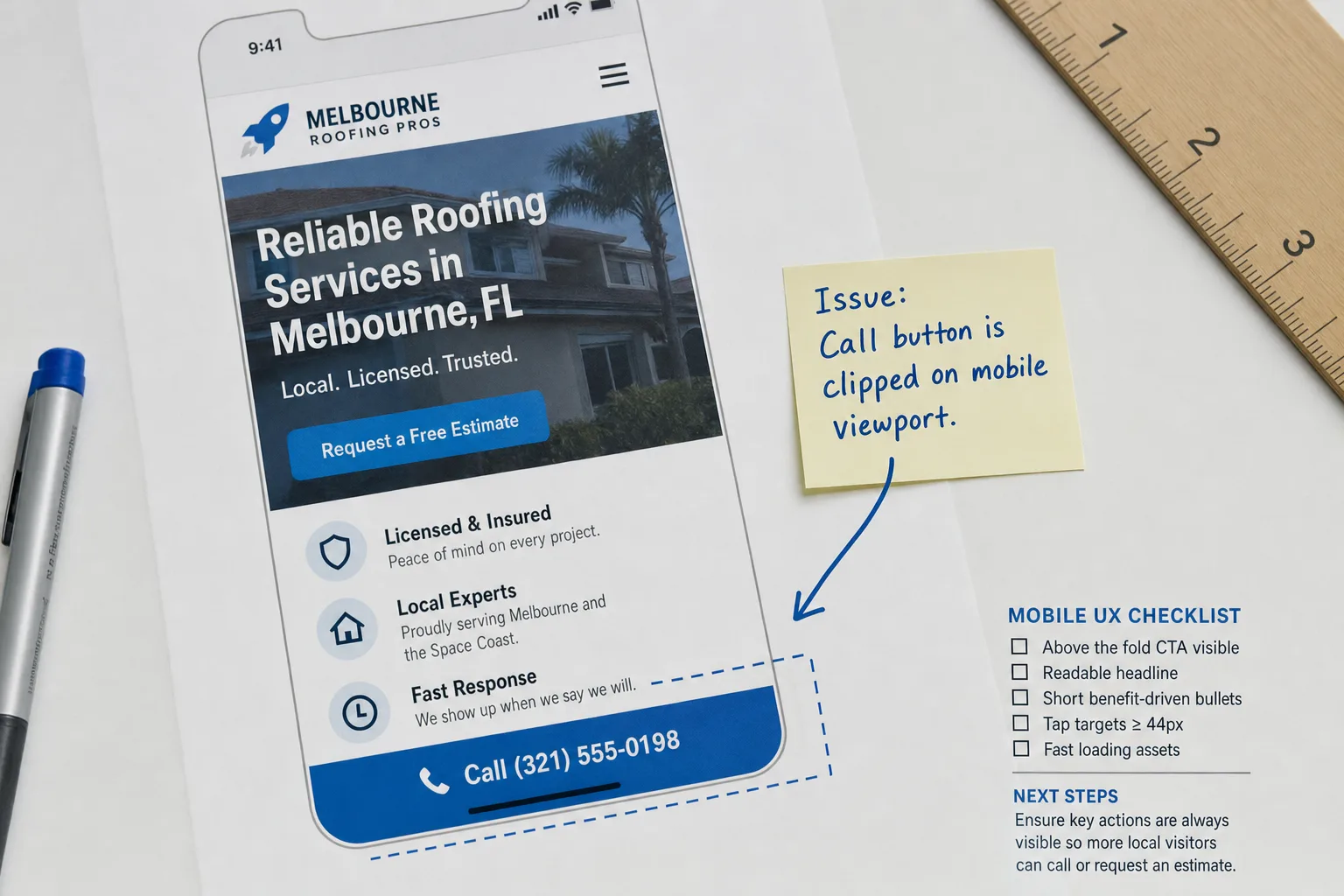
A click-to-call button should be visible, easy to tap, and connected to the correct number. Test it on an actual phone. Watch for sticky banners that cover the button, chat widgets that block form fields, and layouts that clip text at common screen sizes.
A service-request form should collect enough information to qualify the inquiry without creating unnecessary work. Depending on the business, a name, contact method, requested service, and service location may be sufficient for the first conversation. Avoid requiring extensive project documentation before someone knows whether you can help.
Use visible field labels, understandable error messages, and a clear submission confirmation. Test where inquiries are delivered, including spam filtering and any customer-management integration. A form that appears to work but never reaches the business is a lead-generation failure even if its design is excellent.
Measure Inquiries, Not Just Traffic
More visits are useful only when they contribute to business goals. Separate phone-button clicks, successful form submissions, and qualified inquiries in your reporting. A phone click does not prove that a conversation occurred, and a form submission may still be spam or outside your service area.
Where appropriate, connect website reporting with a simple internal lead log. Record the requested service, location, source when known, and whether the inquiry became an opportunity. This helps distinguish a visibility problem from a page-usability problem or a mismatch between the campaign’s targets and the work your business wants.
Redesign, Targeted Updates, or SEO Campaign: Which Do You Need?
The right investment depends on the constraint. Rebuilding a functional website will not necessarily solve a lack of useful service content. Publishing more articles will not repair a broken inquiry form. Diagnose the obstacle before committing to a large project.
| What You Are Seeing | Likely First Priority | What to Verify Before Spending |
|---|---|---|
| The site works on mobile, but important services have little search visibility. | Keyword targeting, content planning, and an appropriately scoped SEO campaign. | Whether relevant pages exist, can be indexed, and explain the services adequately. |
| Visitors reach service pages but rarely inquire. | Targeted page, form, and contact-path improvements. | Traffic relevance, tracking accuracy, mobile usability, and inquiry delivery. |
| The platform is difficult to maintain and core functions repeatedly fail. | A development assessment and possibly a rebuild. | Whether repairs are practical, who owns the system, and what migration would involve. |
| A redesign is already scheduled. | SEO planning and a migration checklist before development is finalized. | Existing valuable URLs, new page structure, redirects, content ownership, and launch responsibilities. |
Example Checklist: A Melbourne Service Business Considering a Redesign
This is an illustrative decision checklist, not a client case study or a claim about results. Use it to prepare for a website and SEO discussion:
- List the main services you want more inquiries for.
- Identify the communities you can consistently serve.
- Record which existing pages already receive useful search visits or leads.
- Test the phone link and complete the inquiry form from a mobile device.
- Check whether each priority service has a useful, accessible page.
- Confirm that articles can be published without rebuilding a template each time.
- Separate visual preferences from broken functions and search-access problems.
- Ask which changes can be handled through targeted updates and which require development.
For many Melbourne FL small business websites, a focused set of improvements may be more appropriate than a complete replacement. Other sites genuinely need a rebuild. The recommendation should explain the business reason for that decision rather than assume that every SEO engagement requires a new website.
How America’s Digital Solutions Aligns Website Recommendations With Keyword Campaigns
America’s Digital Solutions provides turnkey local SEO campaigns, keyword-targeted campaigns, SEO content creation and publishing, categorically relevant backlink acquisition and maintenance, and local SEO consulting with website recommendations. Its role should not be confused with an automatically included, full-service website development engagement.
A website review can identify obstacles and recommended updates. Which changes America’s Digital Solutions can implement, and which require your developer, must be confirmed for your website and campaign. Custom design, platform migration, template development, and advanced integrations should never be assumed to be included without a written scope.
Keyword Count Defines Campaign Scope
Campaigns are sold based on the number of targeted keywords. The selection should reflect your actual services, geographic reach, and business priorities—not simply accumulate as many phrases as possible.
For example, a business focused on Melbourne may need a different keyword scope from a company actively serving Melbourne, Cocoa Beach, and Orlando. Expanding geography is meaningful only when the company can fulfill the resulting demand and the content can accurately represent that coverage.
The campaign discussion should identify the proposed keyword count, the specific targets, and the services those targets support. A larger keyword scope also includes more backlinks. Request the keyword list and the associated deliverables before approving the campaign, rather than interpreting “turnkey” as an undefined package of SEO activities.
Each Targeted Keyword Receives a Keyword-Specific Article
Each campaign keyword receives an article written specifically for that keyword. The article should answer a useful search need while accurately describing the business. Keyword-specific does not mean mechanically repeating a phrase or producing nearly identical pages for every variation.
Articles are published to the client’s website through the agency’s plugin for WordPress, or manually when the website is not on WordPress. Publishing requires appropriate access and a workable content system. For a non-WordPress website, clarify the publishing location, formatting process, access requirements, and any platform restrictions before work begins.
Website recommendations and article publishing should support one another. A helpful article can direct readers to a relevant service page, but that destination must explain the service and provide a functioning inquiry path. If the website lacks an appropriate destination, that becomes a planning priority.
Backlinks Are Acquired and Maintained During the Active Campaign
America’s Digital Solutions describes a network of more than 50,000 brands used to source backlinks from categorically relevant businesses. The campaign model allows links to be established quickly, with more links included as the number of targeted keywords increases. Those links are maintained while the client’s campaign remains active; the model is not a promise of a fresh batch of links every month.
That distinction matters when comparing proposals. Ask what link reporting is provided, how topical relevance is evaluated, where links point, and what maintenance covers. Also clarify what happens to campaign-supported links when service ends.
Network size alone does not establish link quality, Google compliance, or ranking value. Google’s link-spam policies address links created primarily to manipulate rankings. Paid placements should be handled according to Google’s outbound-link qualification guidance, including appropriate use of sponsored or nofollow attributes. No backlink source can guarantee that Google will credit a link or produce a particular ranking.
For the broader service context, review America’s Digital Solutions campaign overview. The useful question is how the proposed keyword scope, articles, publishing process, and maintained links fit your website and commercial priorities.
What to Clarify About Scope, Cost, Launch Timing, and Measurement
Separate the Campaign Price From the Website Quote
America’s Digital Solutions’ smallest SEO campaign is $1,250 per month. Campaign scope is based on the number of keywords targeted, with article and backlink deliverables tied to that scope. A new website build or redesign is not automatically included in the monthly campaign price.
Keep those budgets separate when evaluating the investment. One scope should describe the ongoing campaign. Any development scope should identify the pages, templates, functionality, migration tasks, testing, and implementation responsibilities being purchased.
Ask whether hosting, domain renewal, software licenses, backups, and ongoing technical maintenance are included or billed separately. The answer may depend on your existing providers and platform. The local SEO campaign cost and planning guide can help you frame the campaign portion without treating it as a substitute for a development quote.
Assign an Owner to Every Recommendation
A recommendation is not the same as completed implementation. Before work proceeds, establish who will make each change, who will approve it, and who will test it. This prevents important tasks from sitting between an SEO provider, a developer, and the business owner.
A practical responsibilities list might cover service-page copy, title edits, article publishing, redirects, mobile layout repairs, analytics access, and form-delivery testing. Mark each item as an agency-confirmed update, developer task, or business-owner responsibility. For changes outside the confirmed campaign scope, request a separate estimate or implementation plan.
Also retain business-controlled access to your domain, hosting, website, and reporting accounts. If you are comparing providers, our guide on how to choose an SEO company explains why deliverables, access, and agreement terms deserve attention alongside price.
Distinguish Launch Timing From SEO Progress
A launch date is a project milestone. Search visibility develops on a separate timetable. Development timing depends on content readiness, approvals, platform complexity, integrations, and testing. Search engines then need to discover and process new or changed pages, and indexing is not guaranteed merely because a page has been published.
Rankings may fluctuate after substantial changes. Competitive conditions, the website’s history, query intent, and the broader local market affect progress. A campaign should not be sold as a fixed countdown to a particular position.

SEO planning should start while you can still change the sitemap, page templates, and URL plan easily. If the redesign is already in development, review those elements before launch instead of waiting for a traffic problem to reveal a missed requirement.
Use a Website Redesign SEO Checklist Before and After Launch
- Document the starting point. Save the current URL list and review available search, traffic, and inquiry data.
- Approve the page plan. Decide which pages stay, which change, and where genuinely new content is needed.
- Prepare redirects. Match changed or consolidated URLs to suitable destinations.
- Test the staging website. Review mobile layouts, navigation, content, forms, and performance while keeping unfinished pages out of search.
- Verify launch settings. Remove unintended indexing restrictions from the live site and confirm tracking, redirects, and the sitemap.
- Monitor after release. Check page availability, indexing information, traffic patterns, and real inquiry delivery.
Agree on a reporting cadence and which measurements will be reviewed. Search Console can help evaluate search impressions, clicks, queries, and indexing. Analytics can show landing-page behavior and configured conversion events. Your internal lead records provide the additional context needed to judge inquiry quality and business value.
Melbourne Website Development and SEO FAQs
Do I Need a New Website, or Can My Existing Site Support a Local SEO Campaign?
Your existing website may be sufficient if it works reliably on mobile, supports accessible service pages and article publishing, and provides functional contact options. A review should identify whether targeted updates can address the main obstacles.
A rebuild becomes more relevant when the platform prevents necessary edits, core functions repeatedly fail, or repairs would leave substantial long-term limitations. Visual age alone is not enough to determine that a replacement is necessary. Start with your URL, priority services, and known problems so the discussion can focus on evidence rather than a predetermined rebuild.
Does America’s Digital Solutions Build Websites or Provide SEO Recommendations for My Developer?
Confirmed services include local SEO consulting, website recommendations, keyword-targeted campaigns, content creation and publishing, and relevant backlink acquisition and maintenance. Do not assume that a full website build, custom design, or migration is included.
The consultation should clarify which recommendations need your developer and which updates America’s Digital Solutions confirms it can handle. If you already have a developer, involve that person early enough to review publishing access, page templates, redirects, and implementation responsibilities.
What Does an SEO Campaign Cost, and Is Website Development Included?
The smallest campaign is $1,250 per month, with campaign scope based on keyword count. More targeted keywords mean more keyword-specific articles and more included backlinks. The appropriate scope depends on the services and markets being targeted.
Website development is not automatically included. Obtain a separate written scope for any build, redesign, or technical work that is not expressly confirmed within the campaign. Ask for both the initial project costs and ongoing expenses so you can assess the full commitment.
Can a Redesign Hurt My Existing Rankings, and When Should SEO Planning Begin?
Yes. Removing useful content, breaking established URLs, changing internal navigation, or launching with incorrect indexing settings can reduce search visibility. Even a carefully planned migration can involve temporary fluctuations while search engines process the changes.
Begin SEO planning before approving the new page structure and templates. Preserve valuable content and URLs where practical, prepare necessary redirects, and document prelaunch performance. If the website is already being rebuilt, request an SEO-focused review before the live release rather than waiting until afterward.
Can You Support a Melbourne Service-Area Business Without a Storefront or a WordPress Website?
A public storefront is not a prerequisite for a useful local business website. Service-area businesses should explain where they actually work and avoid presenting fabricated office locations. Eligible businesses using Google Business Profile should follow Google’s service-area and address-display rules; the website and profile should describe the business consistently.
WordPress is also not required for campaign article publishing. America’s Digital Solutions uses its plugin for WordPress websites and manual publishing for non-WordPress sites. Confirm the platform’s capabilities and access process first, because restricted systems may require developer assistance or a different publishing workflow.
Should I Target Melbourne, Cocoa Beach, and Orlando at the Same Time?
Only if those markets reflect your actual operations and priorities. Melbourne and Cocoa Beach coverage does not automatically mean an Orlando campaign is appropriate. Consider travel, scheduling, capacity, and the types of projects you are willing to accept in each area.
Start with commercially important services and realistic coverage. Broader targeting increases the keyword scope and content requirements, so the campaign discussion should explain what each additional market adds rather than treating every city as an automatic opportunity.
Request a Melbourne Website and Local SEO Consultation
The strongest website investment addresses the obstacle between local search demand and a qualified inquiry. That may mean fixing a mobile contact path, improving service content, preserving existing visibility during a redesign, or building a keyword-targeted campaign on an already functional website.
Melbourne business owners can request website development guidance within a turnkey local SEO campaign from America’s Digital Solutions. Bring your website URL, main services, target service area, and any redesign plans. If you already work with a developer, include that information as well.
The consultation can focus on identifying website priorities, discussing keyword scope, and clarifying which recommendations require your developer versus any updates America’s Digital Solutions confirms it can handle. You can also discuss campaign pricing separately from any website build or redesign quote.
Request a Melbourne Website and Local SEO Consultation: call (321) 215-7664 to discuss your current website, planned changes, and the local services you want your campaign to support.


