

SEO vs PPC vs Content Marketing: Choosing Your First Search Marketing Investment
For an Orlando small business, the question is not which marketing channel wins in theory. It is which investment fits your cash flow, how soon you need inquiries, and whether your website can turn visitors into customers.
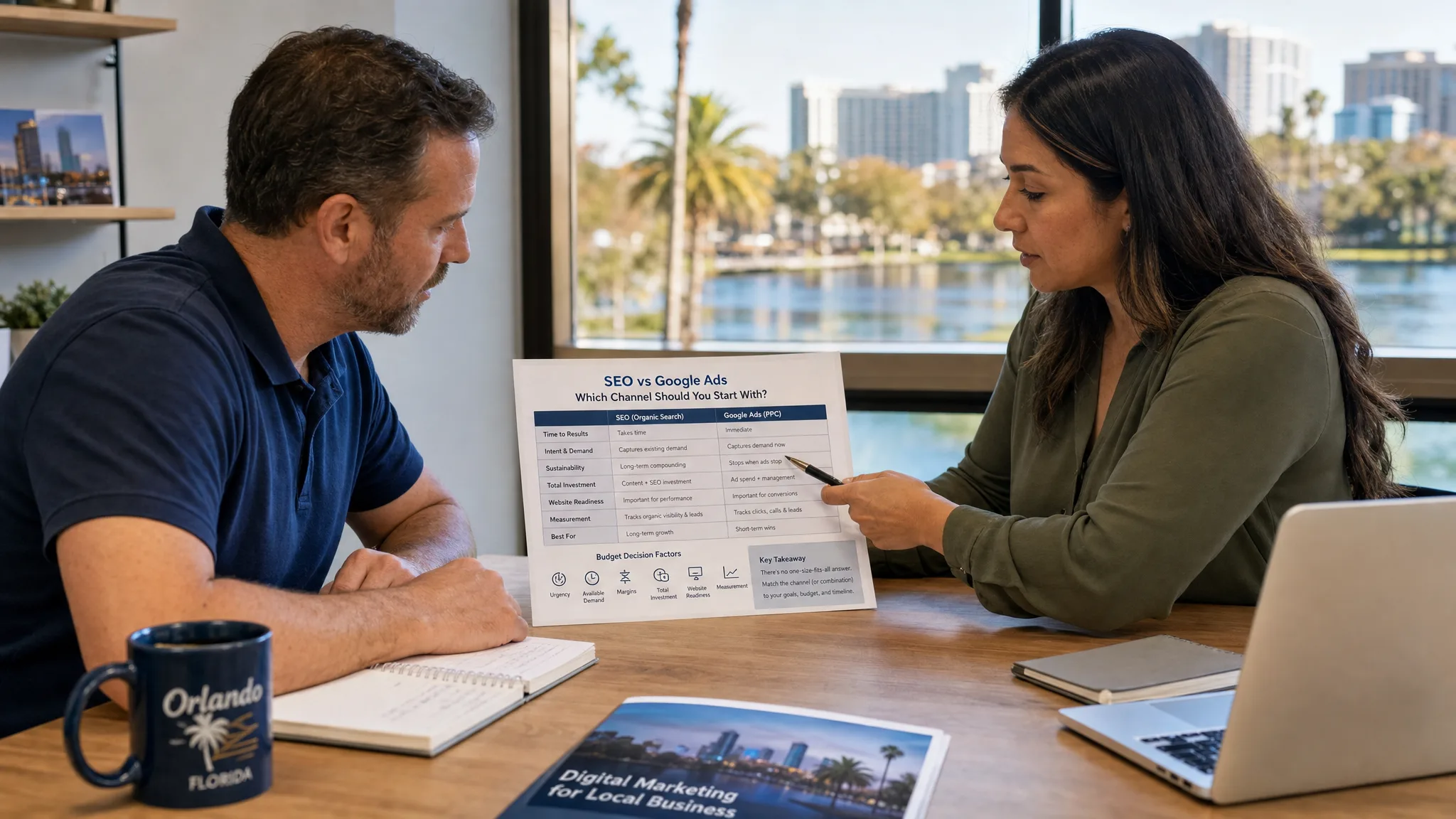
This guide to SEO vs Google Ads for small business compares Google Search ads, organic search, and content marketing without declaring a universal winner. Each serves a different purpose, and the right starting point depends on your services, margins, competition, and ability to measure results.
The Short Answer: Start With Your Timeline, Budget, and Readiness
Consider Google Search ads first when you need to reach existing demand quickly and can fund both the advertising and the work required to manage it. Consider SEO first when you can invest over a longer evaluation period and want to develop visibility beyond paid placements. Use content marketing to answer buying questions, support search visibility, and help prospects decide—not simply to keep a blog active.
These options overlap. A useful service page can support organic rankings and serve as an advertising destination. An article explaining a complicated service can help a prospect who initially found you through an ad. However, each investment needs a clear job and a realistic budget.
Answer these six questions before choosing
- How urgent are the leads? Needing bookings this month is different from building a pipeline for next year. SEO is not a dependable emergency lead source.
- Are people already searching for your service? Search ads capture expressed demand. An unfamiliar service may require education before people know what to search for.
- What can a new customer contribute? Revenue alone is insufficient. Consider direct delivery costs, repeat business, and how many inquiries become paying customers.
- What is your total monthly investment capacity? Separate media spending, management, content, website work, and measurement costs.
- Is the website ready? A slow mobile page, confusing offer, or broken form can waste traffic from either paid or organic search.
- Can you handle and track inquiries? Missed calls, slow estimates, and an overloaded schedule can undermine an otherwise sensible campaign.
Location adds another layer. An Orlando contractor serving only a few neighborhoods should not automatically advertise across Central Florida. A Melbourne professional practice may have little reason to target Orlando if customers will not make the trip. A Cocoa Beach visitor-oriented business may need to reach travelers before arrival as well as people already nearby.
Start with where your customers actually come from, not the largest audience a platform allows you to select.
SEO vs Google Search Ads: A Side-by-Side Comparison
PPC means pay-per-click advertising. This comparison focuses on Google Search ads, not every paid advertising format. SEO concerns unpaid search visibility. Content marketing creates useful material for potential customers and can support search, email, sales conversations, and other distribution channels.
| Decision factor | Google Search ads | SEO | Content marketing |
|---|---|---|---|
| Primary role | Reach people searching for selected services or products through paid placement. | Improve a website’s eligibility and competitiveness in unpaid search results. | Explain problems, answer buying questions, and help people evaluate an offer. |
| Speed | Can begin generating visits after setup, approval, and launch; profitable performance is not immediate or guaranteed. | Usually requires a longer evaluation period, often measured in months rather than days. | Can support sales once published and distributed; organic discovery may take longer. |
| Cost structure | Media spend plus any setup, management, landing-page, and tracking costs. | Campaign fees plus any separately scoped website or supporting work. | Planning, subject expertise, writing, editing, publishing, updating, and distribution. |
| Control | Control over settings such as budgets, targeting, scheduling, and destinations, within platform rules. | Control over your website and campaign decisions, but not Google’s rankings. | Control over the material and distribution you own, but not audience response. |
| When spending stops | New paid traffic from paused ads stops. | Some visibility may persist, but results can change and campaign-maintained resources may end. | Published material may remain useful if retained, accessible, accurate, and discoverable. |
| Typical starting condition | Existing search demand, a clear offer, a conversion-ready page, and room to test. | A sustained budget, relevant services, and patience for uncertain organic growth. | Important customer questions and a plan to put useful answers in front of prospects. |
Google Ads vs organic search is not a choice between paying and getting traffic for free
Organic clicks do not carry a Google advertising charge, but earning and maintaining visibility still takes investment. Paid search charges for access to advertising opportunities, while SEO invests in a different route to discovery. Neither removes the need for a credible website and effective sales follow-up.
Google’s explanation of the ad auction describes how several factors affect whether and where ads appear. Bidding more is not the only consideration. Relevance, quality, auction conditions, and other factors also matter. That is why an unsupported “average Orlando click price” is a weak basis for your budget.
Content marketing is a supporting strategy, not automatically a separate traffic source
An article has no guaranteed audience just because it exists. It needs a useful purpose and a route to readers, such as organic search, email, or a sales follow-up.
For example, an Orlando commercial cleaning company might publish a guide explaining what changes the price of an office-cleaning contract. That guide can help buyers prepare for an estimate. Its value is not limited to ranking for one phrase: it may also improve the quality of inquiries and reduce repetitive questions.
Publishing broad, disconnected articles is different. If the content does not address a real customer decision or connect to a priority service, a growing article count may contribute little to the business.
What Each Channel Really Costs—and How to Judge Return
A useful small business marketing budget starts with the complete cost of acquiring customers, not the most attractive line in a proposal. Ask every provider to separate what is included, what is optional, and what is paid to another company.
Separate Google ad spend from paid ad management
Google Ads costs for small businesses have several components:
- Ad spend: The media budget paid to Google. This purchases advertising, not agency labor.
- Setup: Initial research, campaign configuration, account organization, and launch preparation, if separately charged.
- Paid ad management: Ongoing responsibility for settings, search-term review, negative keywords, budget allocation, testing, and reporting.
- Website or landing-page work: Building or improving the destination visitors use to inquire.
- Measurement tools and implementation: Conversion setup, call tracking where appropriate, analytics, and connections to customer records.
Paid ad management may be billed as a flat fee, a percentage of spend, or another arrangement. Ask whether minimum fees apply and whether landing-page changes are included. A proposal that says “advertising budget” without separating these amounts is not clear enough for a purchase decision.
This article explains paid ad management as a buying consideration. It does not establish that America’s Digital Solutions currently offers that service; confirm any advertising-related scope directly before relying on it.
Also understand how budget controls work. Google’s guidance on average daily budgets explains that spending can vary by day and is subject to applicable spending limits. Do not assume the average daily setting is a hard cap for every individual day. Have the person managing the account explain the rules relevant to your campaign.
Separate SEO campaign fees from other website expenses
America’s Digital Solutions describes its SEO offering as turnkey campaigns priced by the number of targeted keywords, with a starting price of $1,250 per month. That is a campaign starting point, not a promise that every business or market should select the smallest package.
Before signing, confirm the current price, targeted keyword count, publishing deliverables, website work included, reporting, billing schedule, and cancellation terms in writing. A major website rebuild should not be assumed to fall within an SEO campaign simply because both affect search performance.
Content marketing can also involve separate costs. Interviewing a business owner, verifying technical claims, editing a service guide, and distributing it all require resources. Confirm whether proposed content duplicates material already included in an SEO campaign.
Work backward from qualified customers
The following is a hypothetical budgeting example, not an Orlando market benchmark or a forecast.
Suppose a business budgets $1,500 for ad spend, $500 for management, and $300 for initial page and measurement work during a test month. Its total investment is $2,300. If that test produces 20 qualified inquiries and five become customers, the total cost per qualified inquiry is $115 and the acquisition cost per customer is $460.
Now suppose each customer contributes $600 after direct job-delivery costs but before marketing and overhead. Five customers contribute $3,000, leaving $700 after the $2,300 marketing investment and before overhead. If each customer contributes only $300, those same campaign results do not cover the marketing investment.
The lesson is not that those outcomes are likely. It is that identical lead counts can have very different business value.
- Cost per qualified lead: Relevant marketing cost divided by qualified inquiries.
- Customer acquisition cost: Relevant marketing cost divided by new customers acquired.
- Lead-to-customer rate: New customers divided by qualified inquiries.
- Contribution after marketing: Customer revenue minus direct fulfillment costs and acquisition investment.
Use conservative assumptions about repeat purchases. Future revenue is helpful only if customers actually return and the business can afford the initial acquisition cost.
Measure paid and organic search on appropriate timelines
Do not compare a few weeks of SEO with an established ad campaign and declare a winner. Conversely, do not excuse indefinite spending simply because SEO takes time. Agree on review dates and evidence of progress, including completed deliverables, relevant search visibility, qualified inquiries, and customer outcomes.
Google’s conversion measurement guidance explains how advertisers can track valuable actions. For a local business, the useful action is usually closer to a valid appointment request than a page view. A phone-button click is not proof that a conversation occurred, and a submitted form is not proof of a sale.
Keep lead records that identify the service requested, location, source when available, qualification status, and eventual outcome. Without that feedback, an agency may optimize for inexpensive inquiries that your business does not want.
When Google Ads Makes Sense as the First Investment
Google Search ads can be the logical starting point when your business needs to compete for active buying intent now. However, urgency alone is not enough. You also need an offer that can convert and a budget that permits meaningful learning.
You have capacity and a clearly defined service
Consider a hypothetical Orlando repair business with available appointments, reliable call answering, and a mobile-friendly service page. It wants inquiries for one profitable repair category in a limited service area. Paid search offers a way to test that specific combination without waiting for organic visibility to develop.
The manager can focus targeting, review actual search terms, exclude irrelevant requests, and adjust spending based on qualified calls. The business still carries risk: clicks may not become inquiries, inquiries may not become jobs, and competition may make acquisition too expensive.
Your page matches the searcher’s immediate need
Before paying for traffic, check the landing page on a phone. A visitor should quickly understand:
- Which service you provide and whether it matches the search.
- Whether you serve their part of Orlando or Central Florida.
- What the next step involves, such as requesting an estimate or booking a consultation.
- What credible evidence supports choosing your business.
- How to call or submit a short, functioning inquiry form.
A generic homepage with unrelated services can create unnecessary friction. So can unsupported “best in Orlando” claims, intrusive pop-ups, or an estimate form that requires information customers do not yet have.
If the site needs structural improvement, address that before scaling traffic. America’s Digital Solutions discusses website development that supports search visibility, an important consideration whether visitors arrive through ads or organic results.
You can fund a controlled test rather than a last-chance rescue
A viable test needs agreed boundaries: services, geography, media spend, management cost, measurement, review dates, and conditions for changing course. Avoid scattering a limited budget across every service and every nearby city.
For Orlando targeting, review whether location settings align with people physically present in your service area or people expressing interest in it. Those audiences can be very different. A tourism-related business may want both under separate plans; a neighborhood service provider may not.
Advertising should not be presented as a guaranteed rescue for a cash shortage. If the business cannot absorb a test that underperforms, discuss a narrower investment or website repair before committing.
When SEO Makes Sense—and How Turnkey Keyword Campaigns Work
SEO can be the smarter long-term investment when customers consistently search for your services, your business can sustain a longer evaluation period, and you want to build visibility that is not tied to paying for each visit.
That does not make SEO automatically cheaper or permanent. Competitive searches may require substantial investment, and rankings can change as competitors, websites, and search systems change. Google’s SEO Starter Guide explains the fundamentals without promising particular rankings or immediate effects.
Choose commercially relevant searches before expanding coverage
For local SEO in Orlando FL, the starting point should be the services you want to sell and the customers you can genuinely serve. A phrase describing a profitable appointment-based service may be more useful than a broad informational phrase with little buying intent.
Separate Orlando, Melbourne, and Cocoa Beach demand where the business case supports it. These are not interchangeable service areas. Travel time, customer expectations, staffing, and the presence of local competitors can change the value of each market.

The agency’s information on SEO for businesses in Orlando provides a relevant starting point for discussing local campaign coverage.
America’s Digital Solutions’ agency-described campaign model
The following describes the agency’s stated service features, not independently verified performance outcomes or a Google endorsement:
- Pricing is based on targeted keyword count. Campaign size is organized around the number of keywords, rather than sold primarily as hours or a traditional monthly task checklist.
- Each targeted keyword receives a specifically written article. Articles are published to the client’s website through a WordPress plugin or manually for non-WordPress websites.
- The agency describes a network of more than 50,000 brands. It states that campaigns include backlinks from categorically relevant brands within that network.
- Larger keyword campaigns include more backlinks. The keyword count affects both campaign coverage and the quantity of included links.
- Links are maintained while the campaign remains active. The stated model is rapid placement and active-campaign maintenance, not a promise of a fresh batch of links every month or permanent retention after cancellation.
- Website reviews, recommendations, and updates are provided when needed. Confirm the scope of any required changes rather than assuming unlimited development is included.
This model makes keyword selection an important buying decision. More keywords mean a larger campaign, but additional coverage should still match real services, distinct customer needs, and the company’s ability to fulfill demand. A larger brand should ask how coverage will be organized across locations and service lines rather than choosing a count in isolation.
Evaluate backlink practices as well as campaign quantity
A network’s size or topical relevance does not, by itself, establish compliance with search policies or guarantee ranking value. Google’s link-spam policies identify links created primarily to manipulate rankings as a risk, including certain paid or exchanged links. Paid advertising and sponsorship links should be appropriately qualified, such as with rel="sponsored" or rel="nofollow".
Before purchasing any link-inclusive campaign, ask how placements are selected, how commercial relationships are disclosed or qualified, and how the approach aligns with those policies. Do not assume that paying for links buys ranking credit. A provider should be willing to explain its practices and their limitations in understandable terms.
Confirm what the campaign leaves you with
Ask who owns the articles, how publishing access works, whether you can review material for accuracy, and what happens to content, plugins, and backlinks when the agreement ends. Confirm any minimum term, notice requirement, and post-cancellation access in the current agreement.
Turnkey should mean fewer moving parts for the owner—not unclear accountability. You should still understand what you are buying, how business relevance is checked, and how progress will be reviewed.
When to Combine Channels: Orlando Business Scenarios
Many businesses benefit from both paid and organic search, but “use both” is not useful advice unless the budget can support each. A staged combination often makes more sense than dividing a limited budget immediately.
The following scenarios are hypothetical decision examples, not client case studies.
Scenario 1: An Orlando service business needs near-term bookings
The business has appointment capacity, a strong service page, and dependable phone coverage. It needs inquiries sooner than an organic campaign can reasonably be expected to deliver.
Practical sequence: Test narrowly targeted Search ads with a qualified advertising provider. Track booked work, not just calls. Once the business identifies profitable services and can sustain another investment, consider SEO around those priorities.
Content supports the sequence by answering estimate questions and explaining service limitations. It does not need to become a large standalone publishing program immediately.
Scenario 2: An established Orlando company has steady referrals but weak search visibility
This company is not depending on new search leads to cover the next payroll. Its priority is reducing reliance on referrals and becoming discoverable for valuable services.
Practical sequence: Assess website readiness and keyword relevance, then consider a sustainable SEO campaign. Publish useful service-related content and review organic inquiries over an agreed evaluation period. Add paid search later if there is a specific capacity gap or service to test.
The reason to start with SEO is the business’s timeline and goals—not a claim that organic acquisition will always cost less.
Scenario 3: A Cocoa Beach business serves visitors and residents
A visitor-oriented business may encounter people searching before their trip and others looking for an immediate option nearby. Residents may have different questions and repeat-purchase potential.
Practical sequence: Separate those audiences in the plan. Use accurate service and location content to explain availability and logistics. Consider focused advertising around relevant booking windows only when capacity, tracking, and margins support it.
Do not send every audience to the same page or assume that broad regional traffic is equally valuable.
Scenario 4: A Melbourne specialist sells a service customers need explained
A specialist may offer something buyers do not understand well enough to search for by its formal name. Broad advertising could attract research traffic rather than ready customers.
Practical sequence: Build clear service explanations and useful answers to customer questions first. Check whether existing searches describe the problem rather than the technical solution. Then evaluate SEO or a narrow advertising test around that demand.

Here, content marketing improves readiness for either channel. Its first role is making the offer understandable.
Give each channel a distinct job
When combining channels, use shared customer insights without assuming the systems work identically. Paid search can reveal which queries produce qualified inquiries. Those findings may inform organic priorities, but they do not guarantee rankings. Organic content can improve the information available to prospects, but it does not eliminate the need to test advertising destinations.
Also watch attribution. Someone may discover the business through an article and return through a branded ad. A last-click report may credit only the ad. Review brand versus nonbrand demand and customer records before concluding that one channel created all the value.
FAQs About Cost, Timing, and Local Search Results
If I need leads this month, should I choose Google Ads instead of SEO?
Google Search ads are generally the more suitable channel to evaluate for immediate search demand, provided the website, tracking, budget, and lead handling are ready. Ads can begin delivering visits after setup and approval, but that is not a promise of leads this month or profitable results.
If the website is broken or the offer is unclear, fix those issues first. SEO can be planned alongside that work, but it should not be sold as an emergency source of predictable inquiries.
What if my monthly budget cannot support both SEO and Google Ads?
Choose one primary objective and fund it adequately instead of underfunding two channels. If you need an immediate demand test and can afford the complete test cost, discuss focused paid search. If you have more time and a sustainable campaign budget, consider SEO.
America’s Digital Solutions describes its smallest SEO campaign as starting at $1,250 per month. If that commitment does not fit, ask which website or measurement priorities should come first rather than assuming a smaller full campaign is available. Do not commit to a longer-term expense that depends on immediate results to remain affordable.
Do Google Ads improve my organic rankings or Google Maps visibility?
No. Paying for Google Ads does not buy better organic rankings. An advertising placement is separate from unpaid search results. Paid visibility should not be presented as a shortcut to organic or unpaid Maps rankings.
Google’s Business Profile guidance on local ranking identifies relevance, distance, and prominence as the main local ranking factors. Accurate business information and appropriate profile management matter, but no agency can guarantee a specific Maps position. An Orlando address also does not guarantee equal visibility throughout Central Florida.
What happens to traffic and backlinks when I stop paying for ads or an SEO campaign?
When ads are paused, they stop generating new paid visits. Previously acquired customers may return, but the advertising placement itself does not continue without funding.
Stopping SEO does not necessarily erase existing organic traffic overnight. However, rankings can change, competitors continue investing, and content can become outdated. Under America’s Digital Solutions’ described model, campaign backlinks are maintained while the campaign remains active; do not assume those links remain after cancellation. Confirm the exact treatment of links, articles, publishing tools, and access in the agreement.
What should an Orlando business ask an agency before choosing SEO or paid ad management?
Ask questions that reveal financial responsibility and operational fit:
- Which services and locations would you prioritize, and why?
- What is the complete monthly cost, separating media, management, campaign fees, and website work?
- What must be repaired or configured before launch?
- How will qualified inquiries and acquired customers be distinguished from clicks and raw submissions?
- Who owns the advertising account, analytics access, website content, and tracking assets?
- Who is responsible for campaign decisions, approvals, and lead-quality feedback?
- What are the evaluation dates, minimum term, cancellation rules, and consequences of stopping?
- For keyword-based SEO, how many keywords are included, how are they selected, and what publishing and backlink terms apply?
Promises of guaranteed rankings, unexplained bundled costs, and refusal to discuss account ownership are reasons to slow down. For company-specific information, review these questions about America’s Digital Solutions, then confirm the details that apply to your proposed engagement.
Should content marketing come before SEO or PPC?
Sometimes. If prospects cannot understand your service or the website lacks a credible explanation of what you do, foundational content should come first. That may mean improving a service page rather than commissioning many blog posts.
If the website already explains the offer well, content can develop alongside your chosen acquisition channel. Prioritize questions that affect buying decisions: eligibility, service area, process, pricing factors, preparation, and meaningful alternatives. Traffic is useful only when it helps the right people move toward a relevant next step.
Choose Your Next Step With a Free Digital Marketing Audit
The practical answer to SEO vs PPC for small business is conditional. Choose paid search when the immediate opportunity, margins, website, and test budget support it. Choose SEO when a sustained investment fits your timeline and commercially relevant organic visibility is the priority. Use content marketing to make the offer clearer and support discovery and decision-making.
Choose a combination only when each channel has a defined role and enough funding to do useful work. You do not need to launch everything at once, and a website improvement may be the most sensible first investment when conversion barriers are obvious.
Before an audit conversation with America’s Digital Solutions, bring:
- Your monthly budget: The total amount available, including any separate media, management, and website expenses.
- Your desired lead timeline: When inquiries are needed and how long you can evaluate an investment.
- Your priority services: The work you most want, the areas you serve, and available capacity.
- Your current evidence: Website details, recent inquiry patterns, and customer-conversion information if available.
These details help focus the discussion on your search visibility, website readiness, and next practical investment. If advertising is under consideration, confirm whether any paid-ad review or management work is available and separately scoped; do not assume it is included in the free audit.
Not sure which channel fits your budget and timeline? Get a Free Digital Marketing Audit to discuss your search visibility, priorities, and next practical investment. Bring your monthly budget, desired lead timeline, and priority services so you can talk through which option fits your situation best. You can also call (321) 215-7664 to arrange that conversation.


