

What Does SEO Actually Do for a Small Business Website?
SEO helps a website become easier to discover and understand through unpaid search results. For a small business, its practical value is helping the right people find relevant services, evaluate the business, and take a useful next step. But rising organic traffic does not automatically mean your website is reaching people who have never heard of you.
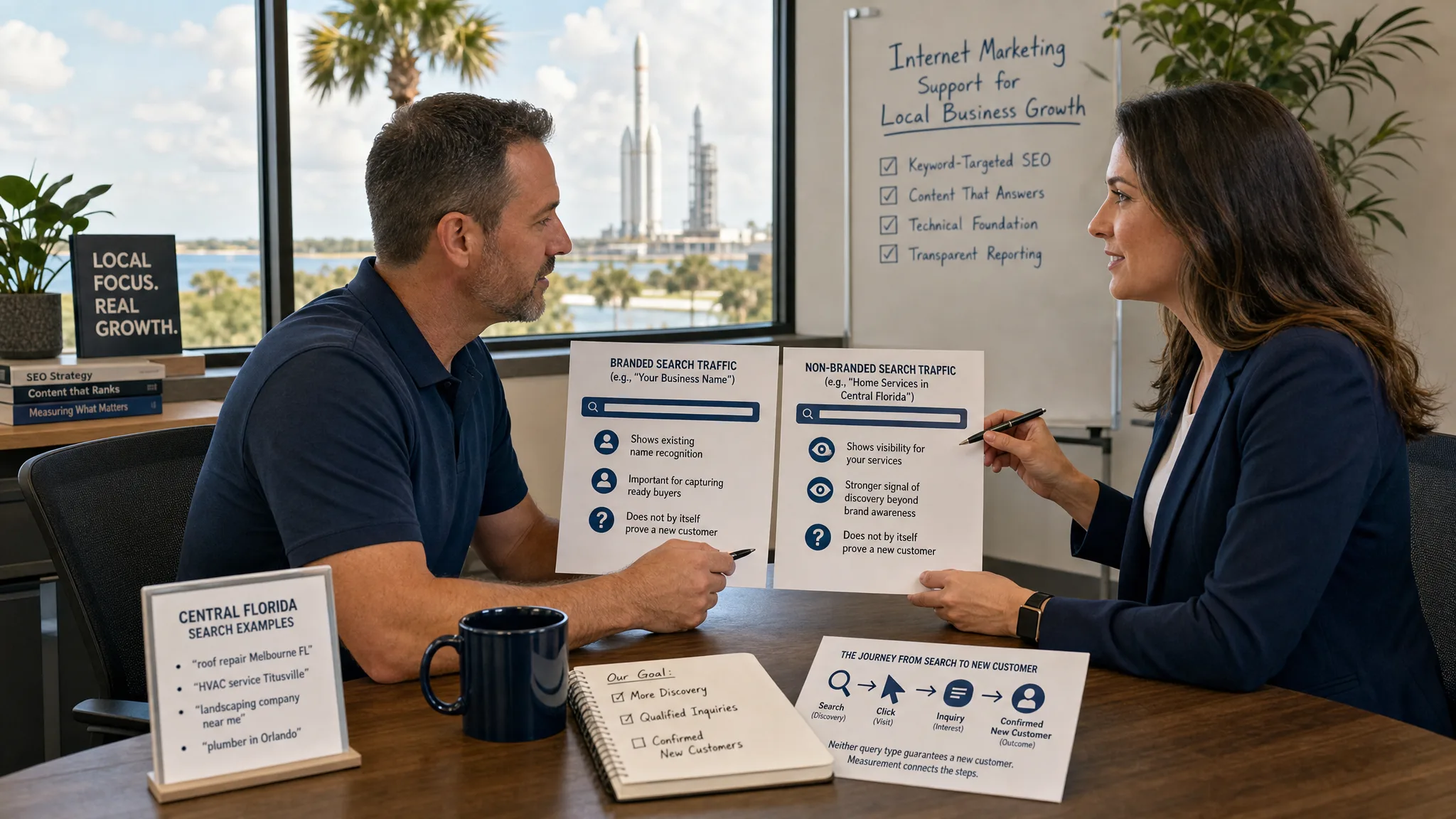
For business owners in Melbourne, Cocoa Beach, and Orlando, comparing branded vs non branded local SEO traffic answers a more useful question: Is search visibility capturing existing name recognition, expanding service discovery, or doing both? Understanding that difference helps you decide whether to broaden keyword coverage, improve landing pages, or strengthen measurement first.
Is Your SEO Reaching New People—or Capturing Searches for Your Name?
Imagine reviewing a report that shows more Google clicks this month. That sounds encouraging, but the business meaning depends partly on what people searched before clicking.
Someone searching for your company name may already know you through a referral, a truck they saw in Melbourne, a previous purchase, or an advertisement. Someone searching for a service without naming a provider may be comparing businesses for the first time. Both searches can produce valuable customers, but they represent different signals.
The following are hypothetical Central Florida examples, not actual client query data:
- Branded: A homeowner searches “[Company Name] Melbourne phone number” after a neighbor recommends the business.
- Non-branded: A homeowner searches “water heater replacement Melbourne FL” without naming a company.
- Branded: A visitor searches “[Company Name] Cocoa Beach hours” after seeing the business on a travel itinerary.
- Non-branded: An office manager searches “commercial cleaning Orlando” while looking for a new provider.
The service searches offer stronger evidence that a business is visible beyond explicit brand-name demand. They do not prove that the searcher is unfamiliar with the business, lives locally, or ultimately becomes a customer.
This distinction matters when evaluating keyword-targeted SEO campaigns. A campaign intended to expand discovery should be assessed against relevant service searches and their downstream business value—not just total website traffic. At the same time, strong branded visibility remains important because people who receive referrals still need to find the correct website and contact information.
Branded vs Non-Branded Local SEO Traffic: A Side-by-Side Comparison
The simplest way to understand branded search vs non branded search is to ask whether the query identifies your business. A city name alone does not make a search branded. “Accountant Orlando” is a service-and-location search; “[Company Name] accountant Orlando” includes brand demand.
| Comparison point | Branded search | Non-branded search |
|---|---|---|
| What the query contains | Your business name, recognizable variation, domain, or another clearly associated identifier. | A service, problem, product category, or location without identifying your business. |
| Hypothetical local example | “[Company Name] air conditioning Melbourne” | “air conditioning repair Melbourne FL” |
| What visibility suggests | People can find you when they already have your name in mind. | People can encounter your business while searching for a need or category. |
| Potential business value | Captures referrals, repeat demand, reputation research, and awareness generated elsewhere. | Supports discovery, provider comparison, and opportunities to earn business beyond name recognition. |
| What it cannot establish | Whether the searcher is an existing customer or a first-time prospect. | Whether the searcher is new to the business, qualified, or ready to buy. |
| Useful next measurement | Whether people reach the right information and complete relevant actions. | Whether service discovery leads to suitable landing pages and qualified inquiries. |
Some queries need judgment rather than automatic classification
A company name made from common service words can create ambiguity. An abbreviation may refer to your business in one query and something unrelated in another. Searches for a practitioner’s name may function as branded demand for a medical or professional-services practice, even without the organization’s name.
For larger brands, product names, acquired businesses, and multiple domains make classification more involved. Establish written rules before comparing reports. Keep ambiguous searches in a separate review group rather than forcing every visible query into a clean-looking chart.
Local intent is not limited to searches containing a city
“Electrician near me” can have strong local intent without mentioning Melbourne or Cocoa Beach. Google may also interpret “emergency plumber” locally based on context. Conversely, a query containing “Orlando” does not prove the person searching is physically in Orlando.
For Central Florida local SEO, evaluate both the service requested and the geographic fit. A search can be non-branded yet commercially irrelevant if it concerns a service you do not provide or an area you cannot serve.
What Each Traffic Type Can—and Cannot—Tell You About New Customers
Good reporting separates discovery from acquisition. The connection matters, but the stages are not interchangeable.
- Click
- A recorded click from a Google Search result to your site, as reported in Search Console. It is not necessarily a unique person, a qualified prospect, or a customer.
- Inquiry
- An actual attempt to contact the business, such as a submitted quote request, booking request, or connected call. A button click alone may not establish that an inquiry occurred.
- Qualified inquiry
- An inquiry that meets your business criteria, such as the right service, service area, project type, and realistic buying need.
- Confirmed new customer
- A person or organization verified through business records as making a first purchase or beginning a first paid engagement with you.
Non branded organic traffic is useful evidence of discovery when its queries match your services. However, an existing customer can search “roof inspection Cocoa Beach” and click the company they already use. A first-time customer can search your exact name after receiving a referral. Query categories describe searches, not customer histories.
Do not credit SEO with creating every branded search
Branded demand may originate from word of mouth, community involvement, offline advertising, social media, paid campaigns, or prior organic discovery. SEO can help capture that demand, but a branded click does not establish which channel initially created the interest.
A prospective customer might discover an article through a non-branded search, return through a branded search a week later, and call after opening the website directly. A report showing only the final visit will miss part of that journey.
Do not treat every service search as a sales opportunity
Consider a hypothetical Melbourne air conditioning business. “How to clean an AC filter” may attract homeowners seeking instructions, while “AC repair service Melbourne FL” more clearly suggests provider selection. Both topics can be useful, but they should not carry identical expectations for immediate inquiries.
The financial question is therefore not simply whether traffic increased. It is whether relevant discovery produced enough qualified opportunities and customer value to justify the investment. Use your actual margins, close rates, capacity, and sales cycle—not an assumed conversion rate borrowed from another business.
How to Compare Search Queries, Landing Pages, and Qualified Leads
You do not need a complicated dashboard to begin. You need consistent definitions, usable data, and a way to connect website activity with what happens after someone contacts the business.
1. Start with a consistent Search Console view
In Google Search Console, open the Performance report for search results. Choose a date range and keep the search type, country, device, and other filters consistent when comparing groups. Review a recent complete period against a comparable earlier period. For seasonal businesses, also consider the corresponding period from the previous year when available.
Understand the report’s main measurements:
- Impressions: How often a result from your property appeared under Google’s reporting rules.
- Clicks: How often users clicked through from those results.
- Click-through rate: Clicks divided by impressions.
- Average position: An aggregated visibility measurement, not one permanent ranking for every person and location.
Google’s Search Console Performance report documentation explains these metrics and filtering behavior. A change in average position can reflect a changing query mix, so do not interpret it in isolation.
2. Build a practical brand-query list
List your business name, common misspellings, domain variations, and distinctive abbreviations. Include associated names only when they genuinely identify the business. A list that is too narrow misses branded demand; one that includes generic service words can accidentally classify useful non-branded searches as branded.
To review Google Search Console branded queries, use a query filter. For a single distinctive name, a “queries containing” filter may be sufficient. For multiple variations, a custom regular-expression filter can group alternatives. Review sample matches before relying on the totals, especially if your name includes punctuation or common words.
Use the corresponding “not containing” or “doesn’t match” option to inspect the visible non-branded group under the same reporting conditions. Save your classification rules outside the report so future comparisons use the same approach.
3. Be explicit about missing query data
Search Console does not reveal every search query. Some queries are anonymized for privacy, and reporting or export limits can restrict the rows available. Query filters also affect which data appears in totals. Consequently, visible query rows do not represent every organic search.
Do not subtract a filtered branded total from an unfiltered total and label the remainder a perfectly measured non-branded audience. Report what you can actually support: branded and non-branded clicks within the available, classified query data, with the limitations noted.
If your reporting connection has no usable query rows, do not invent a split. Check the selected property, date range, filters, and data availability. Landing-page sessions alone cannot tell you whether visitors searched a company name or a service phrase.
4. Group non-branded searches by business purpose
A single non-branded total is often too broad for decision-making. Separate the available queries into meaningful groups such as:
- Core services with clear provider-selection intent.
- Services paired with Melbourne, Cocoa Beach, Orlando, or other supported locations.
- Problem-solving and research questions.
- Services outside your scope or geography.
- Employment, training, supplier, or other non-customer searches.
For a local contractor, traffic from people looking for jobs should not be counted as evidence that residential customer acquisition is improving. For a professional firm, relevant research traffic may support a longer decision process, but it still needs a path toward a consultation.
5. Inspect the landing pages receiving discovery traffic
Within Search Console, examine which pages appear for relevant query groups. Then use analytics to review organic landing-page activity. These are complementary perspectives, not a direct query-to-customer match.
Check whether the destination answers the searcher’s immediate questions:
- Does the business provide the exact service requested?
- Is the service available in the visitor’s area?
- Does the page explain the offer without requiring several additional clicks?
- Is there credible, accurate information that helps someone evaluate the business?
- Can a mobile visitor easily call, request an estimate, or book the appropriate next step?
If several different service searches land on a broad homepage, that is a reason to inspect page fit—not automatic proof of a problem. A focused homepage can work well for a narrow business. A company serving multiple needs may require clearer service destinations. This is where website development in Melbourne that supports search visibility connects discovery with a more useful customer experience.
6. Measure inquiries in GA4, then verify them operationally
In Google Analytics 4, distinguish traffic acquisition from user acquisition. Traffic acquisition helps you evaluate the sources associated with sessions. User acquisition focuses on how users were first acquired within the available measurement. Neither report establishes whether someone is a first-time paying customer.
Configure meaningful lead actions as key events where appropriate. A successful form submission is generally stronger evidence than a visit to the contact page. A telephone-link click indicates intent to call, but it does not prove the call connected or involved a qualified prospect.
Search Console integration adds search reporting context; it does not let you reliably attach each organic query to an individual lead. Consent choices, tracking blockers, cross-device behavior, repeat visits, and offline conversations create attribution gaps. Search Console clicks and GA4 sessions also use different measurement rules and should not be expected to match exactly.

Close the loop with your intake process or CRM. Record the requested service, location, qualification status, and whether the person became a new customer. Asking “How did you first hear about us?” can add context, although customer recall is imperfect.
7. Keep Business Profile activity separate
Google Business Profile searches and interactions are not interchangeable with website organic clicks. A call interaction, direction request, and website click could involve the same person. Adding those measurements together does not produce a unique-customer count.
Use Google’s Business Profile performance guidance to understand the available metrics. For businesses relying on local map visibility, Google Business Profile management can complement website SEO, but reporting should preserve the distinction between profile activity, website visits, and verified inquiries.
What Different Traffic Patterns Mean for Your Next SEO Decision
There is no universal ideal branded-to-non-branded ratio. A well-known regional company, a new Melbourne service business, and a Cocoa Beach business serving visitors will have different demand patterns. The useful question is whether the current pattern supports your growth priorities.
Most visible clicks are branded, and you want more discovery
This can indicate strong name recognition alongside an opportunity to reach service searches. First check whether the available data is representative enough to support that conclusion. Then identify service-and-location terms that align with your actual capabilities, preferred work, and customer economics.
A keyword-targeted campaign may fit if you have a clear offer and can handle additional qualified inquiries. Do not broaden coverage simply to reduce the branded percentage. Branded clicks could increase at the same time, and that may be healthy.
Non-branded clicks are rising, but inquiries are weak
Examine intent and landing-page fit before buying broader coverage. Are the queries primarily informational? Are visitors arriving for services you do not provide? Does an Orlando-focused page receive inquiries from locations outside your service area? Is the form working on mobile?
Also verify the measurement. Missing form events or untracked phone inquiries can make effective pages look unproductive. Conversely, counting every button click as a lead can make performance look stronger than it is.
Qualified inquiries are increasing, but new customers are not
The bottleneck may be after the website visit. Review response times, appointment availability, estimate follow-up, pricing alignment, and qualification standards. SEO traffic and new customer leads are connected, but the campaign cannot independently control the sales process.
For a business already operating at capacity, targeting more profitable or better-fitting work may be more valuable than maximizing inquiry volume.
Relevant non-branded discovery is producing suitable customers
This is a stronger basis for considering expansion. Look for adjacent services or locations you can genuinely support, and assess whether the existing results have enough history to guide another investment.
For larger brands, compare service categories and markets separately. An overall increase can hide weak performance in a priority location. Expanding across Orlando and the Space Coast should follow real service coverage and useful page content, not repetitive pages with city names swapped.
How America's Digital Solutions Builds Keyword-Targeted Campaigns
America's Digital Solutions offers turnkey SEO campaigns priced by the number of targeted keywords, with campaigns starting at $1,250 per month. The central decision is which keyword coverage fits the business—not how many hours of miscellaneous SEO tasks to purchase.
For a Central Florida business, that discussion should begin with priority services, supported locations, customer value, competition, and the website’s ability to serve the intended searches. A larger keyword count is not automatically better if the additional terms attract the wrong audience.
What the keyword-based model includes
- Keyword-specific articles: Each targeted keyword receives an article written specifically for that keyword.
- Website publication: Articles are published to the client’s website through a WordPress plugin, or manually for non-WordPress websites.
- Categorically relevant backlinks: Campaigns include links from relevant brands within a network of more than 50,000 brands.
- Coverage tied to campaign size: Campaigns targeting more keywords include more backlinks.
- Active-campaign link maintenance: Included links are maintained while the campaign remains active. This is not a promise that links remain after cancellation.
- Website support when needed: Website reviews, recommendations, and updates help address issues that may interfere with search visibility or visitor usefulness.
The network enables links to be established quickly; the model is not a promise of a fresh set of links every month. When comparing proposals, ask about the targeted keyword count, article publication process, included backlink coverage, active-campaign terms, and how performance will be reviewed.
Evaluate content usefulness and link implementation, not just quantity
A keyword-specific article should answer the underlying search need and accurately describe the client’s services. Merely repeating a phrase or publishing overlapping pages does not establish value. Google’s SEO Starter Guide emphasizes useful content and helping search engines understand a website.
Backlink evaluation also requires care. Network size, categorical relevance, and participation in a paid campaign do not guarantee rankings or establish compliance with Google’s policies. Google’s link spam policies address links created primarily to manipulate rankings; paid advertising or sponsorship links should be appropriately qualified with attributes such as rel="sponsored" or rel="nofollow".
Ask how links are selected, placed, qualified, and maintained. Those implementation details matter more than assuming a large network is inherently safe or effective. No campaign can guarantee rankings, lead volumes, or a fixed customer-acquisition outcome.

Choose campaign coverage around a business hypothesis
A useful hypothetical campaign hypothesis might be: “We want to improve discovery for the Melbourne services we most want to sell, and we will evaluate relevant query visibility, landing-page engagement, and qualified inquiries.” That is more actionable than “We want more traffic.”
Branded and non-branded SEO are not mutually exclusive purchases. A website can continue serving people who know the business while expanding visibility for people researching its services. The campaign discussion should identify where additional coverage has the strongest business rationale.
Frequently Asked Questions About Traffic, Cost, and Results
If most of my organic clicks come from my business name, is my SEO campaign failing?
Not necessarily. Strong branded traffic can reflect referrals, repeat business, and successful awareness-building. It also matters that people searching your name can find the correct website.
The concern is whether performance matches the campaign’s purpose. If the goal is service discovery, a report dominated by branded clicks needs a closer look at relevant non-branded visibility, landing pages, and inquiries. Evaluate absolute changes in each group rather than assuming a particular branded percentage means success or failure.
Does more non-branded traffic mean I am getting more new customers?
No. It means more recorded clicks from searches classified as non-branded within the available data. Those searches may include existing customers, researchers, job seekers, or people outside your market.
To assess local SEO customer acquisition, look for a progression: relevant service discovery, appropriate landing-page visits, qualified inquiries, and confirmed first-time customers. Use business records to verify the final stage and acknowledge that attribution may not identify every earlier search touchpoint.
How do I separate branded and non-branded searches in Google Search Console?
Open the search-results Performance report, choose a consistent date range, and add a query filter. Use “containing” for a distinctive brand term or a custom regular expression for multiple brand variations. Inspect the matches, then use the corresponding exclusion filter to review available non-branded queries.
Include recognizable misspellings and associated names where appropriate. Remember that anonymized queries and report limits prevent a complete classification of all search activity. If query rows are unavailable, a reliable breakdown must wait for usable data.
How long should I monitor non-branded search performance before changing my campaign?
Use monthly reviews to identify direction, but avoid major changes based on a few days or a handful of clicks. A rolling three-month view can be a practical starting point for discussion, not a guaranteed SEO results timeline. Low-volume services and longer sales cycles may require more observation.
Account for when pages were published and indexed, the competitive environment, seasonality, and whether enough inquiries have occurred to judge quality. A Cocoa Beach tourism-related business may need a seasonal comparison rather than a simple month-over-month judgment.
Do not wait to fix obvious problems such as broken forms, inaccurate service areas, or pages targeting services you do not offer. Distinguish immediate usability repairs from strategic keyword changes that need a broader evidence base.
When does a keyword-targeted campaign starting at $1,250 per month make sense for a Central Florida business?
It can make sense when the business has defined service priorities, a realistic ongoing budget, a timeline compatible with organic search development, and capacity to handle suitable inquiries. The selected keywords should represent customers the business actually wants and can serve.
Compare the investment with your own customer economics. Consider contribution margin, repeat-purchase potential where supported by your records, lead qualification, and sales conversion. Do not use revenue alone or assume every inquiry becomes a sale.
If relevant non-branded visitors already arrive but rarely inquire, resolving intent or page-fit problems may deserve attention before expanding the keyword count. For additional service questions, review America's Digital Solutions’ frequently asked questions and discuss the specific scope you are considering.
Choose Your Next Step With a Free Digital Marketing Audit
SEO can help a small business capture existing demand and earn discovery beyond its name. The right next step depends on which part of that process needs support.
- If branded clicks dominate: Preserve that valuable demand while exploring relevant non-branded service and location opportunities.
- If non-branded clicks arrive but inquiries are scarce: Examine search intent, landing-page fit, contact usability, and tracking before expanding coverage.
- If qualified inquiries arrive but customers do not: Review qualification, response, and sales follow-through alongside campaign performance.
- If relevant discovery produces suitable customers: Consider expanding keyword coverage according to capacity, service priorities, and budget.
- If usable query or lead data is missing: Establish a defensible baseline instead of making a campaign decision from an assumed traffic split.
Get a Free Digital Marketing Audit from America's Digital Solutions to talk through which approach fits your situation. Bring your priority services, actual service area, budget range, desired timeline, and any available Search Console, analytics, or inquiry records. The discussion can help determine whether a turnkey keyword-targeted campaign fits now or whether measurement and landing-page support should come first.
Prefer to discuss those trade-offs by phone? Call (321) 215-7664 to review the gap between your current search visibility and the customers your business wants to reach.


